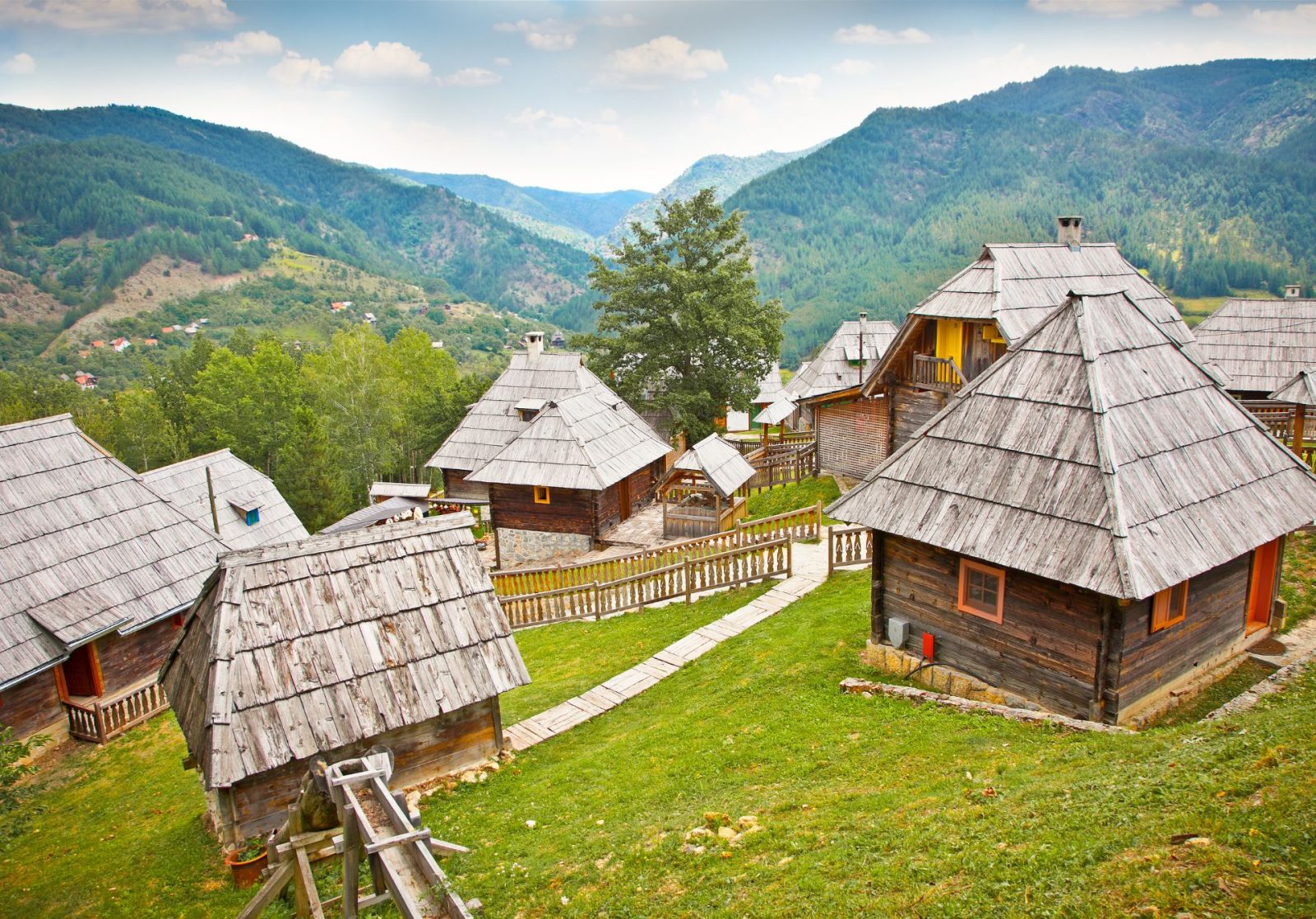
Let’s start with the basics. Drvengrad — which literally translates to Timber Town — is an ethno-village perched atop Mećavnik hill in the Mokra Gora nature park, nestled at the intersection of two of Serbia’s most breathtaking mountain ranges: Tara and Zlatibor. It sits about 210 km from Belgrade and 290 km from Niš, making it a perfectly doable weekend escape from either city.
The village was originally constructed in 2003 and 2004 as a film set for director Emir Kusturica’s movie “Life is a Miracle.” It was simply too charming to demolish after filming wrapped, so it was kept alive and evolved into a living village celebrating Serbian culture. Today it’s one of the most unique destinations in the entire Balkans — and honestly, the world.
The village also goes by two other names: Mećavnik (named after the hill it sits on) and Küstendorf — a German-sounding word combining “Kust” (Kusturica’s nickname) and “dorf” (meaning village in German) — literally, Kusturica’s Village. Call it what you like; it’s utterly unmissable.
The Story Behind the Wood: Kusturica’s Vision
You can’t talk about Drvengrad without talking about its creator. Emir Kusturica is one of the most celebrated filmmakers of our time — a two-time Palme d’Or winner at Cannes — and Drvengrad is, in many ways, his most personal work of art.
When coming up with the idea for his now-famous film, Kusturica stated that he “wished to build his own village,” especially after his birth city, Sarajevo, was badly damaged during the Balkan Wars. The village is based on the architecture of traditional Dinaric-style log cabins that were found around Mt. Tara hundreds of years ago, along with a few aesthetic touches from Kusturica himself — like the colorful red-and-yellow limousine!
Authentic log cabins were brought in from their original locations and placed on stone foundations. The church was built in the tradition of Russian log cabin churches and is dedicated to St. Sava, the founder of the Serbian autocephalous Christian Orthodox Church. Every detail here has been intentional — this is art you can walk through and sleep inside.
Award-Winning Architecture
In 2005, the Brussels-based “Philippe Rotthier Foundation for Architecture” named Drvengrad the best architectural achievement in Europe over the previous three years. The village was also awarded a four-star city-hotel status — the same prestige as Sveti Stefan in Montenegro.
What to See and Do: A Walker’s Dream
Drvengrad isn’t just a pretty backdrop — it’s a fully functioning cultural hub. Here’s a taste of what to expect when you wander through its wooden lanes:
- The Cinema “Underground” — Named after one of Kusturica’s most celebrated films, this cosy cinema screens his works and is a must for any film buff.
- Art Gallery — Rotating exhibitions that reflect both Serbian heritage and contemporary artistic expression.
- The Library — A real, functioning library stacked with books in multiple languages, perfect for a rainy afternoon.
- Traditional Restaurant — Feast on authentic Serbian mountain cuisine; think slow-roasted meats, ajvar, kajmak, and homemade plum rakija.
- Artisan Souvenir Shop — Pick up handcrafted goods, local textiles, and one-of-a-kind keepsakes.
- The Church of St. Sava — A small but beautifully crafted Orthodox church built in the Russian log cabin tradition.
- Street names to spot: Even the streets are named after famous icons like Federico Fellini, Nikola Tesla, Ingmar Bergman, and Diego Maradona — a quirky, delightful touch that reflects Kusturica’s eclectic worldview.
The whole village has a wonderfully surreal atmosphere — part fairy tale, part film set, part living museum. Wooden birds placed on the upper plateau of the main square amplify the somewhat fantastical and mystical atmosphere. Don’t rush it; let the place wash over you slowly.
The Kustendorf Film & Music Festival
If you can time your visit right, the annual Kustendorf International Film and Music Festival is an experience unlike any other on the Balkan travel circuit.
The festival is conceived as an event where young filmmakers and students can meet famous actors and directors, but also as a meeting point of bands and musicians. It typically takes place in January each year and draws a crowd of global cinema talent to this remote hilltop village — creating a magical, almost surreal contrast between the snowy mountain landscape and the buzz of the international film world.
Mokra Gora was also recognized as the best village by the UNWTO, giving the wider area a well-deserved global stamp of approval that continues to draw curious travellers from across Europe and beyond.
Getting There: Your Options at a Glance
Getting to Drvengrad is easier than you might think, and the journey through western Serbia’s mountain scenery is half the fun.
- From Zlatibor (most popular base): Zlatibor to Drvengrad is less than 40 km away and a 40-minute drive. It’s scenic, easy, and totally doable as a day trip.
- From Belgrade: Drvengrad is located about 200 km from Serbia’s capital and takes around 3 hours to reach.
- From Sarajevo: About 2.5 hours and 140 km away — a great day trip from Bosnia.
- On foot from Mokra Gora: It’s only 1.5 km from Mokra Gora village — you can go by foot! Uphill, but worth every step.
- By organised tour: Day tours run regularly from Belgrade and include the Šargan Eight railway ride — a great combo package for first-timers.
To reach Drvengrad by public transportation from Zlatibor, take a bus to Mokra Gora (about 30–40 minutes), then either walk approximately 2 km or take a local taxi — fares typically run around 300–500 dinars.
Staying Overnight: Sleep in the Story
Here’s our insider tip: don’t just visit Drvengrad for a few hours — stay the night. Waking up in a hand-hewn log cabin on Mećavnik hill, surrounded by pine forest and mountain air, is an experience that’s hard to beat anywhere in Serbia.
- Wooden cabin accommodation: You can stay overnight in one of the wooden houses or at the hotel complex right within the village itself.
- Drvengrad after dark: Once the day-trippers leave, the village takes on an entirely different energy — lantern-lit, quiet, and deeply atmospheric.
- Best time to visit: Spring and autumn offer the most pleasant weather, though winter has its own storybook magic — especially during the film festival in January.
Pro Travel Tip
Pair your Drvengrad visit with a ride on the legendary Šargan Eight railway — a narrow-gauge mountain train that spirals through tunnels and bridges in a figure-eight formation nearby. The two experiences together make for an unforgettable day in western Serbia.
What’s Nearby: Extending Your Adventure
The Zlatibor and Mokra Gora region is packed with things to see and do beyond Drvengrad. Consider adding these to your itinerary:
- Šargan Eight Railway — A UNESCO-recognised narrow-gauge steam train experience through dramatic mountain scenery.
- Sirogojno Open-Air Museum (“Staro Selo”) — Dozens of 19th-century wooden buildings from surrounding villages were moved here to recreate a traditional settlement, complete with authentic cottages, a blacksmith’s forge, a bakery, and a small wooden church.
- Stopića Cave — One of the most spectacular caves in Serbia, just a short drive away.
- Zlatibor Lake — Perfect for an easy stroll, boat rental, or a slow afternoon coffee with mountain views.
- Andrićgrad, Višegrad (Bosnia) — Another Kusturica-designed town across the border, dedicated to Nobel Prize-winning writer Ivo Andrić — an ideal companion trip.
Final Thoughts: Why Drvengrad Deserves a Place on Your List
Drvengrad (Mećavnik) is one of those rare destinations that genuinely defies easy categorisation. It’s a film set that became a village, a village that became a cultural institution, and a cultural institution that still manages to feel intimate, personal, and alive. Whether you’re a cinephile who grew up watching Kusturica’s films, a history lover drawn to Serbia’s rich Dinaric heritage, a foodie eager to taste mountain cooking at its finest, or simply a traveller who wants to stumble into something beautiful and unexpected — Drvengrad delivers on all fronts.
It’s only a few hours from Belgrade, sits within easy reach of Zlatibor’s broader tourism network, and offers accommodation that’s genuinely one-of-a-kind. In a world full of cookie-cutter destinations, Drvengrad stands proudly, beautifully, defiantly different.
Our recommendation? Build at least one night into your stay, ride the Šargan Eight, eat well, and let Mećavnik hill work its quiet magic on you. Serbia’s western highlands are waiting — and Drvengrad is the perfect place to start.